Search This Blog

Monday, May 11, 2015

Me Version 5.0: Time for an Upgrade

    I'm overwhelmed, but I'm pretty sure no one knows it.  I try not to let on that I'm unhappy with my self-discipline and lack of focus.  I simply am not the recreation superintendent and educator I want to be. Everywhere I turn (in my office and with my schedule) I feel that I can't make any significant headway.  Every good intention seems to be thwarted by my own disorganization, stacks of things to read, and desire to handle work projects and obligations with professional efficiency and mastery.  In short, this sucks.  I suck.
    Don't get me wrong, things are great at home and with my health, but this current version of "me the professional" is not cutting it.  It's not the jobs - I love what I do.  I have great staff/co-workers who do great work.  My students are great and are very responsive in class and in the work they turn in.  My boss is supportive and happy with my performance . . . but I am not.  I know I can do better and, just like I'm typing this with only two-fingers, I know I am not making the most of my time, resources, and basic organizational skills.

    Wally Bock's Leading Yourself: A Baker's Dozen of Things to Master provides a simple list of actionable things I can do to help move myself into a more productive, efficient, and engaged mode professionally.  I know this will take time and that new habits must be practiced (30 days for it to really take hold and 10,000 hours of committed practice to demonstrate mastery), but I don't want to look back a week from now, a month from now, or a year from now and say, "If only I had started back then . . ."  It's going to take time to get organized and practice to stay organized, but like Walt Disney said, "The way to get started is to quit talking and begin doing,” and “The secret of juggling many responsibilities is organization."
   Let's get started . . . . 

Sunday, July 20, 2014

TWO VIDEOS YOU CAN USE FOR SOCIAL MEDIA TRAINING AT WORK

In my Brand+Aid blog article, Six Helpful Hints to Get Your Social Media Up and Running, I talk about how we developed a team approach to social media management in my agency. It wasn't something that we implemented overnight.  It took time and we learned as our strategy developed, experiencing both successes and failures, but always trying to do it better and efficiently.  And it's been fun - a necessity if anything's going to keep my interest for the long haul.

For me, learning how to use social media involved trial and error, reading articles and books, and attending educational and training sessions.  Another great source is YouTube videos.  One of my favorites is The Social Media Revolution.  This video makes a compelling case for businesses, like parks and recreation, to use social media.  This link is for the 2014 version, but you might enjoy some of the earlier versions (my favorite is from 2010, but that's because I love the rockin' soundtrack).
Another really good video was produced for a government agency in Victoria, Australia, that we've simply . . . 'borrowed".  Like them, we use it for staff training for social media in the workplace.  It's brief, engaging, and high quality.  In my agency every employee is asked to watch this video, participate in a discussion about social media in the workplace, and sign a social media user agreement.  Signing the agreement is not required, but necessary if they want to participate on our official Facebook department newsfeed, which is our ongoing department newsletter and is well utilized.

Social media isn't going anywhere.  It will continue to grow and evolve.  Leaders need to come to grips with that and use it to their advantage as opposed to avoiding it and banning it from the workplace.  It's the next step in the evolution of communication. Those who resist evolving run the risk of becoming obsolete and irrelevant.

Monday, March 31, 2014

I Want To Change The World, But Am I Qualified?

    In the article, "Why Great Managers Are So Rare", the author talks about how "Gallup finds that companies fail to choose the candidate with the right talent for the job 82% of the time."   That means less than 20% of the time people hired or promoted to a management position are actually ready or capable of high performance in a management position.  Yikes! 

    I'm a manager, so of course I'm now worried that I'm one of the 82%.  I'd like to think I'm doing pretty good, but truth is I'm certain I am deficient in certain areas.  Perhaps that's an advantage for me.  By being aware and asking my boss and subordinates (I hate that word) for feedback, such as, "what do you think I could do better?", I think helps me look at my skills and actions with a critical eye.  I believe we should always look to improve our competencies and that we will never be perfect or ideal.  I will always be a work in progress.  So does this mean I'm not a good choice to be a manager?

    The article talks about five (5) traits common among great managers: they motivate every single employee to take action and engage employees with a compelling mission and vision; they demonstrate assertiveness to drive outcomes and the ability to overcome adversity and resistance; they create a culture of clear accountability; they build relationships that create trust, open dialogue, and full transparency; and they make decisions based on productivity, not politics.  No argument here that these five traits are important, but I think there's so much more that needs to be included - additional traits if you will - and some of them are learned, while others are not.

    Here's the additional traits I think all managers should have or try to develop: a passion for the work to being done; demonstrating professional pride through discussions on core values, mission and collective impact on the community; care and respect for bosses and subordinates; a good life - work balance, by placing family first, having fun, and being active, and encouraging co-workers, especially subordinates, to do the same; patience with staff and the process (probably the greatest skill I've learned from my boss); a calm demeanor, especially when others worry or panic; a positive attitude each day and in every encounter with staff and customers; the ability to laugh at yourself (as Mike Veeck says, "we take ourselves not seriously at all . . . we take our business very serious."); a willingness to 'pitch in' when others need help or are short-handed; walk the talk by modelling the type of behavior they want to see others emulate; be professionally engaged with others in the industry (network and give back to the profession through service and leadership), and; a mindset of curiosity - always wanting to learn, grow and improve, and encouraging others to better themselves, even in ways that might not seem to be directly related to the business.
Mike Veeck at the 2013 Brand-Aid Conference in Arlington, TX.

    That's my list for now.  What am I missing?  Is there anything on the list that you think doesn't belong?  I know some items could be combined with the original five traits, but I don't believe the author meant that the list was finite. 

    I love being a manager.  I love my staff, working for my boss, and I can't think of a better organization for whom to work.  I love field of parks and recreation.  I love teaching part-time at the university in the recreation, parks & tourism department.  And of course I love my wife and kids.  So while I may not be the perfect manager or in the 18% of great ones, I sure hope I'm good enough to lead my team in the direction of doing great things for the community, and that they are each able to enjoy their lives at work.  Perhaps that's what managers need to do in order for their staff - the ones doing the really important work - to make a difference in the community.  Perhaps that's what's needed to change the world.

Monday, September 16, 2013

Quit Talking and Begin Doing

    Last spring I was feeling down about a new skill I was trying to develop.  I was beating myself up for not having learned this skill when I was young, as I figured most people would normally do.  After an in-depth discussion with a friend about my frustration I was feeling better and decided to tweet a thought to serve as a reminder to myself (and to actually use Twitter).  It said, "Don't let a late start keep U from enjoying the journey. So U didn't start when U were young, big deal. You're going now. Enjoy the ride. " 
 
   I still get those feelings of disappointment and have to continually remind myself that it's OK to be a beginner.  Better to start now and do the best I can rather than be 10 years older and regret not having started 10 years ago.  Plus, I don't have to play catch-up.  Those feelings I have of being 30+ years behind - it's all in my head.  I am where I am.  If I keep at it for another year I'll be another year along and hopefully another year better.  I gotta enjoy the ride . . . and some rides aren't easy.
 
    So what do you want to try?  What's keeping you from taking a chance?  I took Walt Disney's advice: "The way to get started is to quit talking and begin doing.”   Whether it's in your personal life or your work life, give it a shot and don't live with the old adage:  “For all sad words of tongue and pen, The saddest are these, 'It might have been'” – John Greenleaf Whittier.
    For years I have been collecting quotes I find online, in books and articles, and even in places of business.  This set is from my 'taking chances" file.  Enjoy!

“Anyone who has never made a mistake has never tried anything new.”
Albert Einstein

“If we did all the things we are capable of, we would literally astound ourselves.”
Thomas A. Edison

“One of the greatest discoveries a man makes, one of his great surprises, is to find he can do what he was afraid he couldn't do.”
Henry Ford

“We would accomplish many more things if we did not think of them as impossible.”
Vince Lombardi

“If you shoot for the stars and hit the moon, it's OK. But you've got to shoot for something. A lot of people don't even shoot.”
Confucius

“The limits of the mind are often mistaken to be the limits of the world.”
Immanuel Kant

"If we never took a risk our children would not learn to walk, climb stairs, ride a bicycle or swim; businesses would not develop innovative new products, move into new markets and create wealth for all; scientists would not experiment and discover; we would not have great art, literature, music and architecture."
Sir Digby Jones

"Far better it is to dare mighty things, to win glorious triumphs, even though checkered by failure ... than to rank with those poor spirits who neither enjoy much nor suffer much, because they live in a grey twilight that knows not victory nor defeat."
Theodore Roosevelt
 
“There is no passion to be found playing small - in settling for a life that is less than the one you are capable of living.”
Nelson Mandela


"Man cannot discover new oceans unless he has the courage to lose sight of the shore."
Andre' Gide

“I'd rather regret the things I've done than regret the things I haven't done.”
Lucille Ball


 "Your time is limited, so don't waste it living someone else's life. Stay hungry. Stay foolish..."
Steve Jobs

"When you're curious, you find lots of interesting things to do. And one thing it takes to accomplish something is courage.”
Walt Disney

“You've got to go out on a limb sometimes because that's where the fruit is.”
Will Rogers

“After all these years, I am still involved in the process of self-discovery.  It's better to explore life and make mistakes than to play it safe.  Mistakes are part of the dues one pays for a full life.”
Sophia Loren

Monday, January 7, 2013

Leadership and Customer Service - Key strategies for the business of parks and recreation

    "Government should be run more like a business," is a line I've often heard, and is mentioned in the article, Comparing Business to Government, by Arnie Biondo (from the February 2012 issue of Parks and Rec Business magazine).  I've struggled with what this means, but Biondo's article does a very good job laying out the differences between business and local government, as well as detailing some strategies professionals and agencies can do that are, as Biondo states, "more business-like practices." 
    The first strategy mentioned is the delivery of excellent customer service, which is something we strive to provide at the West Sacramento Parks & Recreation department.  Just to say you have great customer service isn't enough, and it can't be inconsistent (great by one staff member, but poor by another).  It has to be a cultural norm, but it can only be the norm if the leaders are working on setting the tone and nurturing the culture to help it grow and mature.  I'm pleased to say that just this past Saturday I spent some time with some of our recreation center front-line staff (front desk, lifeguards and child care staff) as they participated in another leadership/management/customer service training.

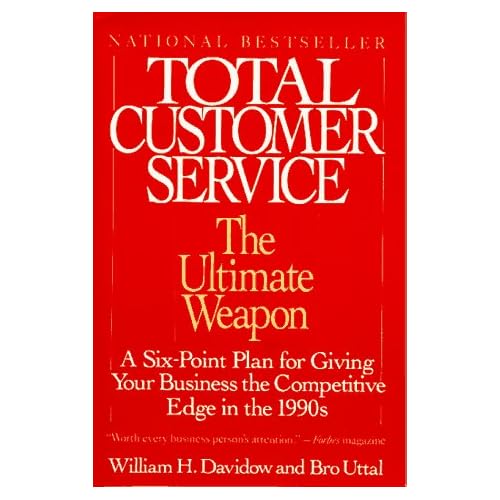
    William Davidow and Bro Uttal, in their best-selling book, Total Customer Service: The Ultimate Weapon*, provide a list of three (3) principles that they say leaders of customer service oriented companies do:  
1.      Foster a service oriented culture. Leaders help create and nurture cultures by communicating use. They put values into action by treating employees exactly as they want employees to treat customers.

2.      Make customer service everybody's business. Unless every employee assumes responsibility for the customer’s experience, service dies.
 
3.   Declare war on bureaucracy. To produce effective, efficient Customer service, leaders keep policies, procedures, and other formal control mechanisms to a minimum, relying instead on cultural control.
    As I go down this list of strategies, I find that we are applying these business strategies.  Leadership is key (and we are fortunate to have a department director and City Council who provide solid leadership) and having and implementing a thoughtful and deliberate customer service strategy is critical if parks and recreation agencies are to deliver on their vision and mission and not run like stereo-typical government.

*This is a great book, but was published in 1989.  While some of the examples given are antiquated, the definition and strategies are still very relevant. 

Thursday, January 3, 2013

Sir . . put the iPhone down and step away

It needed to happen.  I think I started to feel it was becoming an issue over the summer, but it finally came to a head on Christmas Day.  "You're always on your phone or tablet when we're together," my wife told me.  She was right.  If not for Alene speaking her mind (not something she has trouble doing by the way) I don't think I would have made the decision.  And while her words did sting a little, I decided to turn this issue into a positive.  I would make a decision that shows her that I respect her feelings, while trying to strike a balance in my life.  This knuckle-dragger may evolve a tad!

Social media, personal and work email, videos, a few games, news, and blogs - it had become a problem and she was right to point it out.  Having a smartphone, tablet, laptop, and a PC at both home and work have made it very easy to be online almost every waking moment where I am sitting down, standing around, and, occasionally, while walking.  I had become one of them . . . one of the people who had become too connected . . . one of the people I hear others comment about.  I see this behavior lampooned in Facebook posts . . .
as well as the old fashioned way - the comic strips . . .

So, the day after Christmas I developed a strategy to not only minimize using my devices when around my wife, but I developed four (4) simple guidelines for how I want to use technology out and about during my day, as well as while I'm at home.  I want to make sure I strike a balance and don't go to the other extreme or set rules that will result in my failure.  While I suspect this list will be modified over time and possibly grow, it's a start .  Check it out and let me know if you think I missed something or if you think something should be tweaked a bit.
  • Be present for them (even though they may not be). When with the wife or family don't be checking your smartphone or tablet for emails, texts or social media. Save that for when everyone's gone to bed, especially your wife.  Exception:  if asked by a family member to take a picture with my smartphone or to check something on Facebook, do so, but then put the device down when finished - don't continue to stay on checking statuses or emails.
  • Place books you want to read (in most cases this means books you mean to finish) in places where you sit around the house.  Time spent checking Facebook posts or emails could be spent reading some books you've wanted to finish and finally start some books you'd really like to get into.  You could also practice guitar more . . . which you enjoy and really need to do.
  • Challenge yourself to not check your smartphone when you are meeting with other people.  Wait until you have time to yourself afterwards or are back in your office.
  • It's so easy to check your smartphone when standing in a line, walking around, as a passenger in a car, in between sessions at a conference or during baseball or football games.  Challenge yourself to not do so because you've got nothing else to do or are bored.  Exception: you like taking pictures and using filters (often times for work purposes) - as this is one of those great features of your smartphone continue to do so, but be sensitive that you are not missing something or are a distraction for others who are trying to enjoy the moment or your company.
Mobile devices are fantastic, but like watching too much television, mobile devices, I believe, can have an adverse affect on my ability to engage in daily living and take away from my quality of life.  But the pendulum does not need to swing all the way to the other side.  I can find that balance.  I do not want to be dependent on mobile technology or social media.  Instead I want these things to serve my interests and enhance my life.  

It needed to happen.  Using these guidelines to shape my own behavior will be a challenge, but making these changes may help me be more engaged with others, give me time to read more books, and practice guitar more.  Who knows . . . by this time next year playing an F7 may be a piece of cake, and both China Grove and Sweet home Alabama may actually sound like music.


Sunday, December 9, 2012

Make No Mistake . . . Work Should Be Fun and Passion-driven

    As 2012 starts to wind down, so too does the semester at Sacramento State, where I've had the privilege of teaching a graduate course on the advanced administration of parks, recreation and tourism.  I taught this course once before 6 or 7 years ago and focused on management, but this time I took a different approach.  This semester the areas of focus were on leadership and customer service.  While it is fun to teach this class (and I believe I have the experience and qualifications to do so) I find that I am as much a student during the semester as any of the dozen graduate students I have.  The course is billed as a 'workshop', and it is very much an open forum during class and we supplement discussions using our class Circle on Google+.  Using social media to further our discussions and share new information and experiences has really added value to this course - so much so that I will use Google+ in all my classes in the future.

    One shared post that really hit home with me was called the 9 Crippling Mistakes CEO's Make (thank you Jen Smith).  For me it was affirmation on my leadership and management beliefs and practices, but it also made me think that it is some of these very points that may keep me from ever becoming a parks and recreation director.  


    I see a trend in our profession that concerns me: director and administrator positions being filled with people who may have a strong business or finance background, but lack a true understanding of, and passion for, parks and recreation.  While I would agree that it makes sense to apply smart business practices to what we do, we are not the same as a small business, a large corporation, a non-profit or just about any other department found in local government.  Leading a parks and recreation department around by the budget as a means to make it perform (a.k.a. - avoid going over budget), isn't how a leisure service agency is going to excel.  Squelching the creativity of people whose jobs are to create opportunities for their customers (residents) and whose jobs are to help foster positive emotional connections within the community is a sure way to under-perform.  The role of parks and recreation is to help improve the quality of life for the people living within that community. Do that and your customers are likely to talk about how much they love their community and others will want to make that community their community.  That's how you grow and maintain a healthy bottom-line.  I've seen this happen.  It's has happened in the community where I work (West Sacramento) because of the vision, talent and love my staff have for the community and work we do.

  
Whether it's celebrating Stars Wars Day (May the 4th), Talk Like a Pirate Day, or some other reasons to play with our customers, community and staff, setting the tone for a fun work place yields positive business results.

   And it's not just my department.  The other department's in our organization are similar in their passion for their work and commitment to serving the community. Beyond that there has been the political-will to take West Sacramento in a positive direction.  It really is a wonderful place to live, work and play!

   So back to my point.  Our department - Parks & Recreation - is successful because we follow our mission and strive to deliver exceptional customer service.  Item #3 in the linked article is You ignore the importance of company culture.  I'm big on company culture and feel one of the main roles of a leader is to help set the tone, then get out of the way and let your talented staff do their jobs.  You foster an atmosphere where people want to work because it's fun and challenging and the customer feels it.  Make the customer 'part of the show', and they become a partner in your success.  Not sure about that?  Look at Disney theme parks.  Need I say more?


    Item #4 is You focus too much on the numbers; I review our budget once a month to see how we're doing on expenses and revenue, and I see purchase orders almost daily - that's about it.   Unless I see something that's not trending as it has the past couple of years, or see expenses higher than normal, or revenue lagging lower than projected, I don't worry about it.  My staff know what they have to spend and they know their revenue targets.  It is working because once again we came in under budget and exceeded revenue projections (we did have a rough few years due to budget cuts, but the City has managed this challenge very well).   Here's my thinking about managing a budget.  It's a tool (as my Director likes to say) to help me do my job.  That means the budget is not my job, but a means to help me do the business of parks and recreation.  


The last point in this article is the most powerful: #9 You forget the noble purpose.  Why did we get into parks and recreation in the first place?  Why do we put so much time and effort into programs and events?  Why do we design, build, and maintain parks and facilities for people to use?  The answer is passion.  I've heard colleagues describe their career in parks and recreation as 'a calling'.  Like me, they can't see themselves doing anything else.   It makes us happy.


How about you?  Are you passionate about what you do?  If you're a leader in your organization, work group, or team, do you see yourself as a successful leader or are you hindered by some of the 9 Crippling Mistakes CEO's Make?